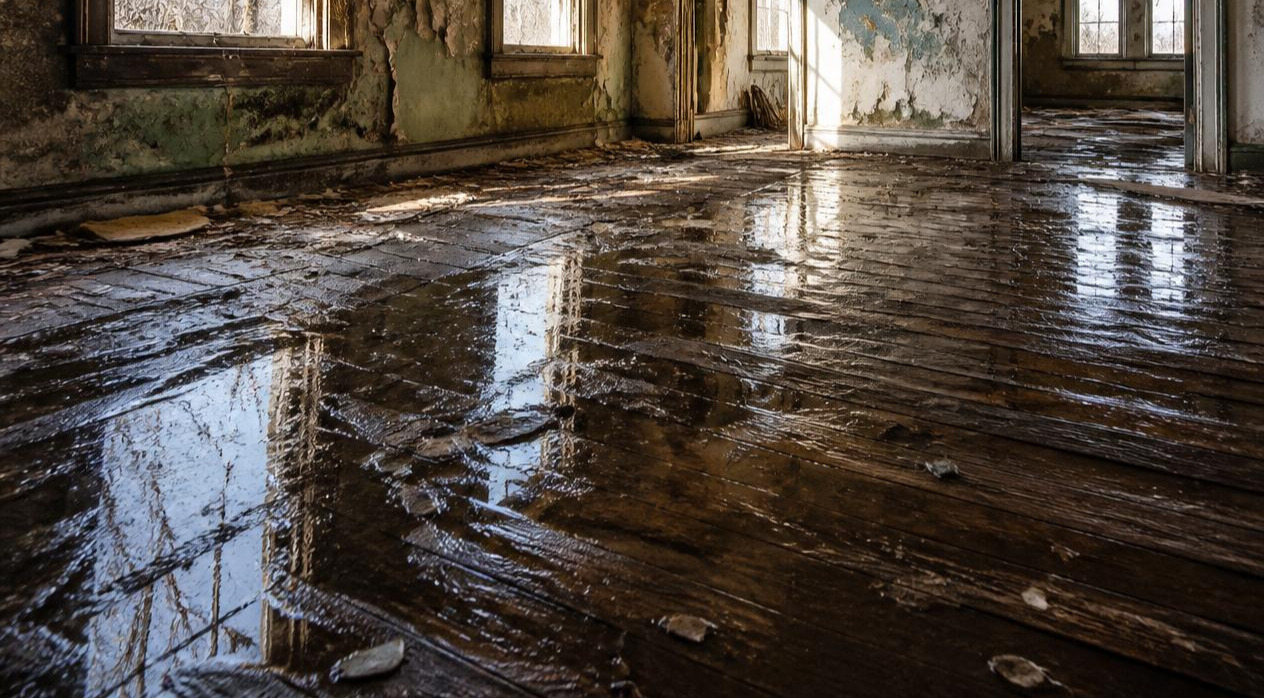
Floors take the worst of most household leaks, simply because water runs downward and pools. Water damaged floor repair isn’t one process — it depends almost entirely on the flooring material, since hardwood, laminate, carpet, and tile all respond to water completely differently, and some can be dried and saved while others are essentially a lost cause once soaked.
How to Tell If a Floor Has Water Damage
- Cupping or crowning in hardwood — boards curling up at the edges (cupping) or bulging in the middle (crowning) as they absorb moisture unevenly
- Buckling or warping — visible waves or lifted sections, most common in laminate
- Soft or spongy spots underfoot, especially near baseboards
- Discoloration — dark staining, especially at seams or edges
- Musty smell coming from the floor, particularly noticeable with carpet
- Peeling or bubbling in vinyl or linoleum sheet flooring
- Loose or hollow-sounding tiles — water under tile can break the bond with the subfloor adhesive
Repair vs. Replace by Flooring Type
Hardwood
Solid hardwood is one of the more forgiving materials — if the water is caught within a day or two, cupped boards will often flatten back out once fully dried, sometimes needing a light sand and refinish afterward. Engineered hardwood is less forgiving because the plywood core underneath the veneer delaminates when saturated, and that damage doesn’t reverse.
- Usually salvageable: solid hardwood with mild cupping, caught early, clean (Category 1) water
- Usually not: engineered hardwood that’s been wet more than 24–48 hours, or any hardwood exposed to Category 2/3 water
Laminate
Laminate is the least forgiving common flooring material. It’s made of compressed fiberboard with a printed layer on top — once that core absorbs water, it swells permanently and doesn’t return to its original shape, even after drying.
- Usually not salvageable once water has gotten under or into the boards, regardless of how quickly it’s caught. Laminate is typically a full replacement, not a repair.
Carpet
Carpet itself can sometimes be saved (professional extraction and steam cleaning can salvage carpet fibers exposed to clean water), but the padding underneath almost never can. Padding acts like a sponge and rarely dries fully or evenly, and left-in-place wet padding is one of the most common sources of ongoing musty odor and mold after a water event.
- Carpet: salvageable if clean water and dried within 24–48 hours
- Padding: replace in almost all cases involving standing water, regardless of category
Tile and Vinyl
Tile itself is water-resistant, but water can get underneath through grout lines or damaged sealant and affect the subfloor or adhesive. A hollow sound when tapping a tile usually means the bond has failed underneath.
- Tile: usually fine on the surface; the concern is what’s happening below it
- Vinyl sheet/plank: water-resistant on top, but seams can let water through to the subfloor over time
Subfloor
Whatever the visible flooring, if water reached the subfloor (plywood or OSB) and it stayed wet, it’s a separate problem from the flooring itself — a warped or soft subfloor needs to be addressed before any new flooring goes down, or the new floor will fail the same way.
The Drying Process (When Drying Is the Right Call)
For materials worth trying to save:
- Remove standing water immediately with a wet/dry vac
- Increase airflow — fans positioned to move air across the surface, not just into the room
- Run a dehumidifier continuously, not intermittently, to actually pull moisture out of the air rather than just circulating damp air
- Check moisture levels with a moisture meter against a dry reference area — professional restorers typically don’t call a floor “dry” until readings are close to that baseline, not just “not wet to the touch”
- Allow adequate drying time — professional-grade drying of a saturated floor typically takes 3–5 days minimum; humid climates or thick materials take longer
Rushing this step is the most common DIY mistake — refinishing or covering a floor that looks dry on the surface but is still damp underneath traps moisture in and often leads to mold or a repeat failure.
What It Costs
| Flooring Type | Repair (small area) | Replacement (per room, ~200 sq ft) |
|---|---|---|
| Hardwood (sand/refinish, $3–$8/sq ft) | $600 – $1,600 | $2,000 – $5,000+ (full replacement, $8–$25/sq ft) |
| Laminate | Not typically repairable | $500 – $2,000+ |
| Carpet + padding | $150 – $400 (padding only) | $1,000 – $3,000 (carpet restoration runs ~$4.75–$10.50/sq ft) |
| Tile | $200 – $600 (regrout/reseal) | $1,500 – $4,000 |
| Subfloor replacement | $250 – $750 (per ~150 sq ft) | $1,000 – $3,000 (before new flooring goes down) |
These figures are broadly consistent with 2026 cost data from HomeGuide and Angi.
When to Call a Professional
- Any flooring exposed to Category 2 or 3 water (appliance backups, sewage, floodwater)
- Water that’s been present more than 24–48 hours
- Visible or suspected mold under the flooring
- Uncertainty about whether the subfloor was affected — this isn’t visible without pulling up flooring or using moisture-detection equipment
- Large areas (multiple rooms or an entire level)
Preventing Repeat Floor Damage
- Address appliance leaks (dishwashers, washing machines, refrigerators) the moment they’re noticed — these are among the most common sources of slow floor damage since they often go unnoticed for weeks
- Use area rugs with breathable, non-trapping backing near entryways and kitchens rather than rubber-backed mats that trap moisture against the floor
- Check under-sink cabinets periodically for slow leaks, since floors near sinks are a common failure point that’s easy to miss
The Takeaway
The single most important decision in water damaged floor repair is knowing which materials are worth drying and which aren’t — hardwood and tile often survive a fast response, while laminate and carpet padding usually don’t, no matter how quickly you act. When in doubt about what’s happening beneath the visible surface, a moisture reading is worth more than a visual inspection.